Essay Writing.
Brainstorming your college essay, be authentic.
It’s hard to tell readers who you are in 650 words.
What motivates you, what formed your opinions, what you value. You want them to know it all, we help you tell your story.
If someone picks it off the floor will they read it an know it’s you? That’s the goal.
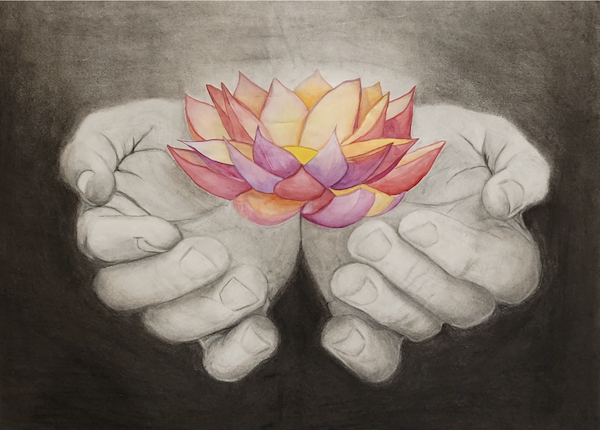
Zara worked beautifully in graphite and colored pencil to show the beauty she was able to produce with her hands.
“We read her essay and think it’s wonderful! I really, really liked it. I know it was a lot of work (and re-work, and re-re-work), but it is really good. Thanks again for all your help with it.”
“Maya’s portfolio and essays were brought to the next level by working with Laura and Florence. They were both kind and encouraging. They really set Maya up well for a successful college application process! Thank you to ARTriculate!”
Many parents think that there’s just one essay to write, the Personal Statement for the Common Application, but that couldn’t be further from the truth. Many schools have additional, shorter, supplemental essays such as:
“Why [College Name]?”
“Why this major?”
“Brown students care deeply about their work and the world around them. Students find contentment, satisfaction, and meaning in daily interactions and major discoveries. Whether big or small, mundane or spectacular, tell us about something that brings you joy.”
Write a short thank-you note to someone you have not yet thanked and would like to acknowledge. (We encourage you to share this note with that person, if possible, and reflect on the experience!) (UPenn)
Writing your college essays is hard work. They often require thinking deeply about you and your experiences and how those experiences will contribute to a college’s community. They take thought and time to develop, they aren’t written in one sitting. We work with students to communicate their thoughts as they answer the specific questions in the applications.
This is a lot to focus on in 12th grade, when you are also focused on your academics, completing your portfolios or audition materials, and attending National Portfolio Day or Unifieds. The essays are one of the most important aspects of your application as it is what is uniquely personal to you and can let admissions committees really learn who you are and why they should accept you into their community.
If you’ve finalized your college list and need help brainstorming, editing or proofreading your essays, we’re here to help you too.
Have questions? Brainstorming, revising, editing, we do it together.
-
The Common Application Personal Statement (Personal Interest Questions in the University of California application) allows you to show admissions what is uniquely personal to you and why they should accept you into their program. It is the cornerstone of almost every school’s application review.
-
Besides the personal statements, most schools have supplemental essays. It’s not uncommon for a student applying to 10 schools to write upwards of 20 responses, some as short as 100 words, others as long as 500 words. They all need to be authentic and often require you to research specific programs and let schools know why they interest you, how you are prepared to study them, and how you will add to the knowledge and composition of the department.
Sometimes these essays are buried in Slideroom or Accept’d, we make sure you know all your essays before we brainstorm what to write.
-
Together we analyze all the required essays (no essay is optional) and strategize how to answer them so you keep peeling back your experiences.
We help you keep track of the prompts, and brainstorm and research responses. You do the writing and we discuss and give you feedback. Once we have a strong version that we agree on we help you edit your words.
-
In addition to these personal statement and supplemental college essays, if you’re applying to creative programs you might also need to write an artist statement which speaks to why you do your art, what influences you, and what you want to do in the future with your art.
Visual artists must also write descriptions of the work submitted in your portfolio, again, it’s wise to take advantage of this opportunity to let the admissions committee learn more about you and your art.
Filmmakers almost always must write a short story or personal (artist) statement.
Well crafted statements can definitely make the acceptance difference.
-
Your artist statement speaks to why you do your art, what influences you, and what you want to do in the future with your art.
It often becomes the narrative that ties the application together. The statement connects directly to the portfolio, helping the admissions committee understand not just what they’re seeing, but how you think about your work and your process.
When it’s done well, it shows the evolution of your ideas across the portfolio and carries that thinking into the writing. This gives context to the work and helps the committee see the intention behind it.
-
Visual artists must write descriptions of the work submitted in their portfolio. This is an opportunity to help the admissions committee understand what they are seeing and how you think about your work.
Each program evaluates work differently, so the writing needs to align with the portfolio and the specific submission requirements. We look at how the work is presented, where context is needed, and how each piece connects to the overall portfolio.
When done well, the writing adds clarity to the work and helps the committee see both the finished piece and the thinking behind it.
-
Filmmaking is storytelling in its most complete form as it includes visual and audio. Many film programs require you to write short stories or scripts, sometimes in response to a prompt.
Students applying to all of the most common film programs have often written up to 20 individual prompt responses.
In our film coaching, students develop an original concept, shape it into a complete story, and produce a finished piece. They receive structured critique throughout the process so the final work is clear and intentional.